Showing posts with label Prague. Show all posts

Sunday, November 27, 2011

Final Fav Fotos

In Prague:
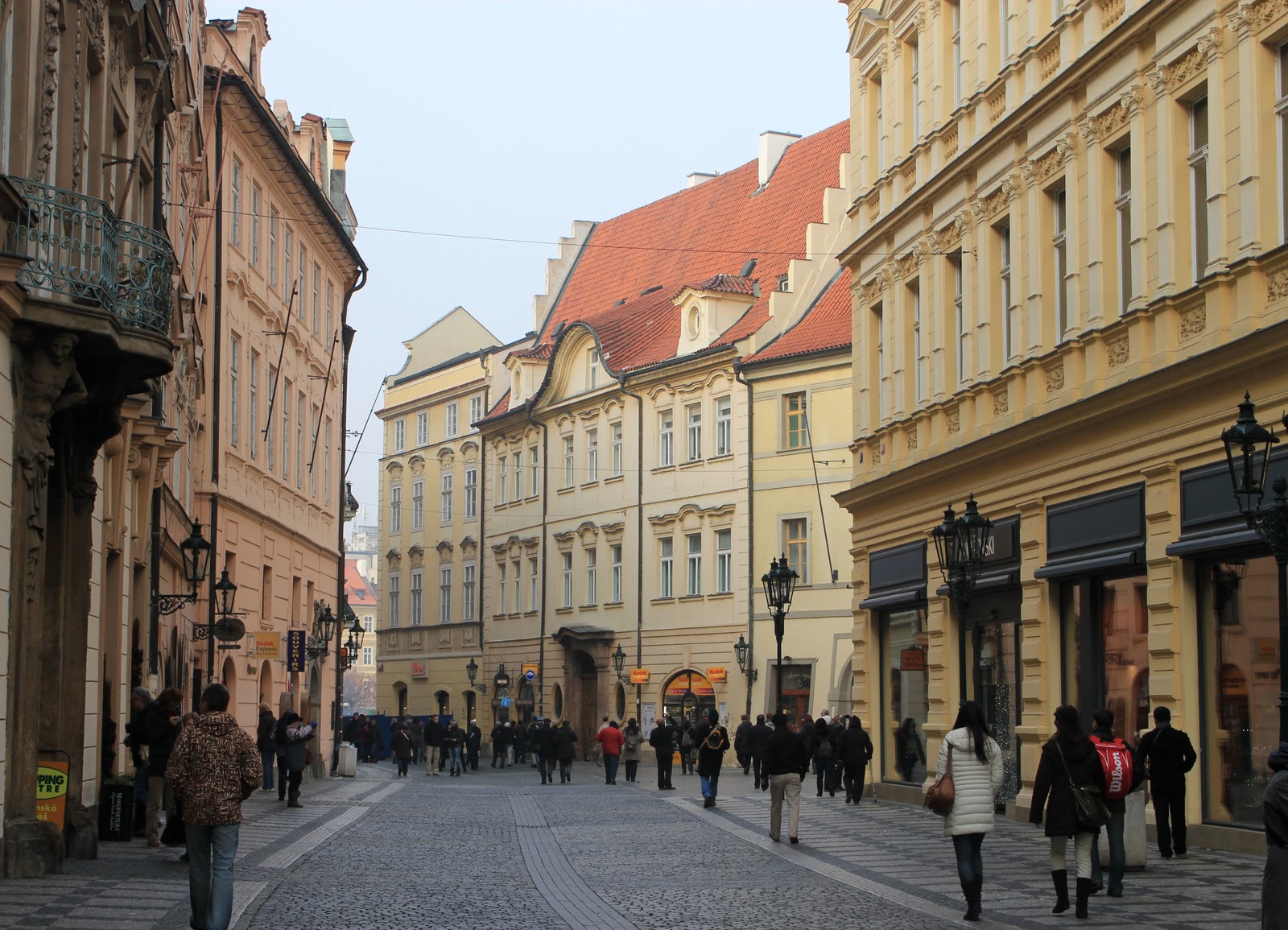
Just a small sampling of the beautiful buildings

Wide pedestrian only streets equals happy tourists

Little Quarter and the Castle above

Old Town Square, vibrant at all hours
 

Friday, November 25, 2011

A Statuesque City

Hope you all had a Happy Turkey Day! Given the business of a holiday weekend, today and tomorrow will just be a few of my favorite photos from our Prague trip. Enjoy!


Wednesday, November 23, 2011

Tick Tock

One final Prague write-up because I never mentioned one of the city's most famous sites: the Town Hall Astronomical Clock. This thing is quite a feat. The clock dates back to the early 1400s and is the oldest one still working in the world. This being medieval times, the clock section shows the earth at the center of the sun and the moon. Oddly to me, the clock is not supposed to tell exact time, but rather, show the orbits of the sun and moon around the earth as well as the sun and moon moving through the signs of the Zodiac. The clock actually indicates time in three different ways, one using a 24 hour clock based on the setting sun, one indicating time as we know it today, and a third showing twelve parts of the visible part of the sky, which is called Babylonian time. The bottom circle is a calendar (this part was added in the 1800s). So all that's sort of interesting, but the best part happens at the top of every hour, when the statues on the side of the clock come to life. The skeleton inverts an hourglass and pulls on a rope. Beautiful wooden sculptures of 11 of the Apostles of Jesus (plus Paul to make 12) pass by and look out the windows, and after they're finished, the clock chimes the hour. For our visit, the chiming clock was followed by a trumpeter at the top of the tower playing a tune on all four sides while dressed in a medieval costume. A fun way to ring in another hour of life.

Monday, November 21, 2011

Seeing Prague

Saturday, we decided to concentrate on the Old Town area in the morning, and walked just about every street. Of the 160 photos we took, more than half of them are pictures of buildings or architectural details of buildings. The city is amazing! Statues hold up balconies, art deco railings abound, rooflines are spires or stepped or have cupolas, some exteriors have frescoes, some have intricate plasterwork. I couldn't get enough of it, and thankfully, Prague does not have dog poop covering the streets, meaning we could walk with our eyes up to our hearts' content. We walked to the edge of the pedestrian zone to a medieval tower, once an entrance to the city, and gazed in awe at the Municipal House next door, an Art Nouveau extravaganza. My favorite was the stained glass awning over the entrance into the lobby, which now houses two restaurants, while the building elsewhere holds exhibition halls, popular for concerts.

For our afternoon, we took a tram ride across the Vltava River to the district above the Castle, then walked down the street enjoying the views of church spires. Making our way to the castle entrance, we walked around the grounds (free), but elected not to tour the buildings, painting gallery, or church. Our feet were aching, and it was time for a break.

Sunday was our day to walk the Jewish Quarter. Prague's Jewish population were essentially walled into their ghetto and experienced a great deal of oppression up until the late 1700s, when some of the more flagrant discriminations were relaxed. Fun Fact: The word ghetto comes from the Italian verb, gettare, which means to throw or to cast. In Venice, Jewish people were forced to live in an area near the copper foundry (il ghetto). The entire Jewish neighborhood became known as a ghetto, and then the word spread in usage to refer to Jewish neighborhoods in other cities. And that's where the word ghetto started...all roads lead back to Italy. But let's head back to Prague - the Jewish Quarter has about six synagogues open for touring and, more interesting to us, the Jewish cemetery, in use from 1478 to 1787. We wanted to see this place in person because the pictures were so amazing. Due to scarcity of land, people were buried 12 deep, with headstones crowding around, but estimates are that over 100,000 are actually buried in this location. The ticket entrance was steep, but after we visited our once actual tourist site for the trip (Museum of Decorative Arts), I headed for a bathroom break and found that the ladies' room overlooks the cemetery. Sweet - I had a great view.

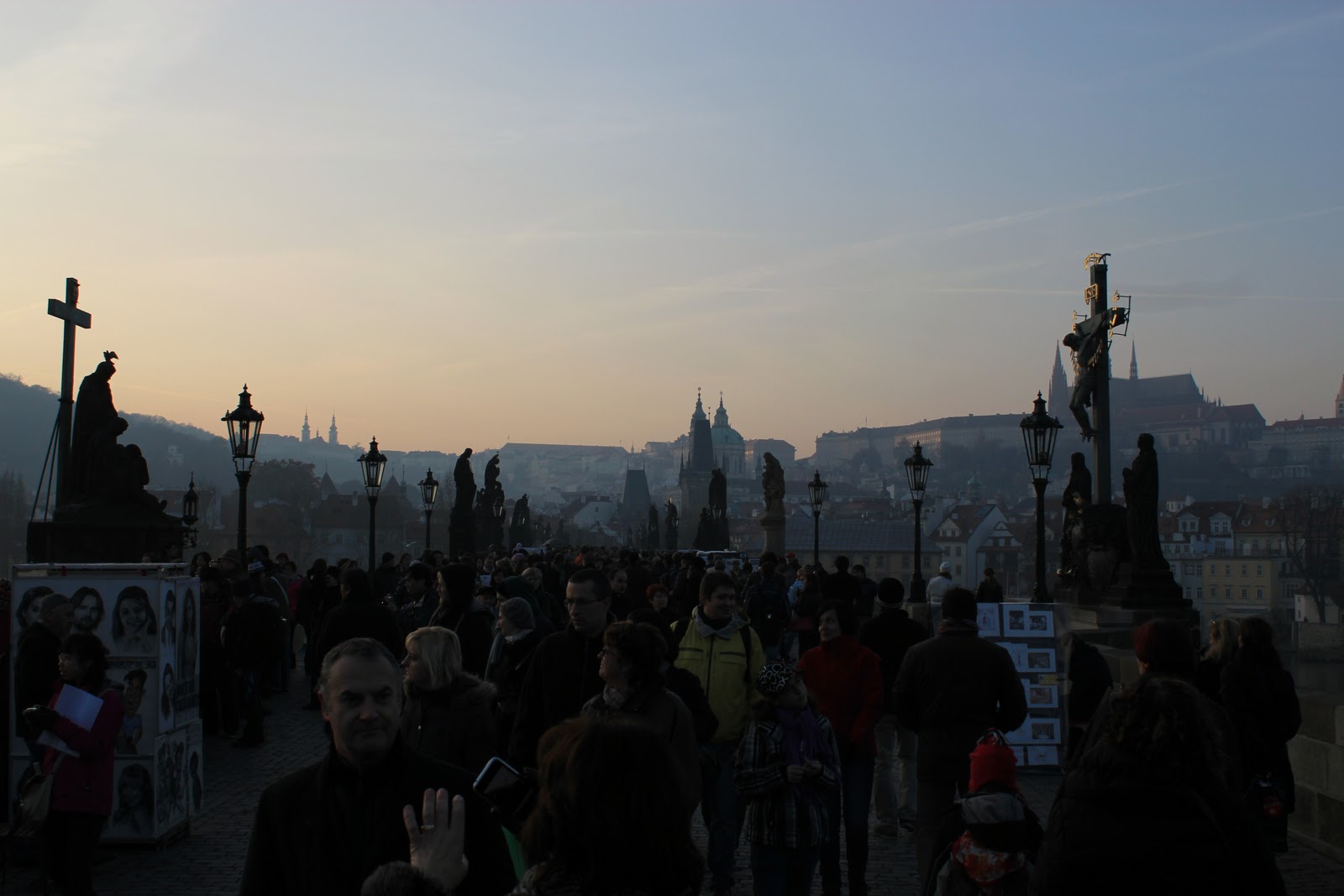
A late lunch in an Irish pub and some relaxing with our Kindles gave our feet time to rest before our next jaunt, back over to the Charles Bridge in search of some street art. I had a picture in my head that I wanted, and while we didn't find it, we got one I like even better. And lots of our own photos as well. We must have spent a good hour goofing around on the Bridge before the cold set in. While in search of a warm pub and some hot wine, we instead found an outdoor cafe using space heaters. Less than 30 degrees outside, and the outdoor cafe was open. After taking a look at their cozy chairs, we had to try it out. Hot Wine and Honey Cake (sooooooo delicious) for me, and for Nathan, a real Budweiser. Another Fun Fact: Two companies from Budweis, Bohemia (now part of Czech Republic) began exporting their Budweiser beer to the U.S. in 1871 and 1875, respectively. Anheuser Busch began selling a Budweiser beer in 1876 and put some sort of copyright or patent on the name. And thus, over a 100 years of legal disputes began. As of now, American Budweiser is sold as "Bud" in the EU, and only the Czech company can use Budweiser. I don't know what name the Czech beer gets in the U.S. But in the U.K., both companies are allowed to use Budweiser. All very complicated, and frankly, annoying. Well, not really for me since I don't care anything about beer, but I am extremely annoyed on behalf of the beer lovers in the world. For all you Budweiser/Bud/Budvar (yet another name used) lovers: Na Zdravi (to your health, which is just a fancy way of saying cheers):

Look At That Building!

My cold is finally waning such that I can do more than stare around the house bleary eyed and sniffling. So...I can start my posts about our trip last weekend, which we spent in gorgeous, beautiful, stunning Prague (location of the INXS video for "Never Tear Us Apart," and a city Nathan's wanted to visit since seeing the video as a teen)! Nathan named this blog post because that's all he heard for three days. We visit many beautiful cities, but Prague is surely the most comprehensively beautiful. Every single street is lined with gorgeous buildings - Renaissance, Baroque, Gothic, Art Deco, all the styles are there in a hodge podge of colors, rooflines, fanciful decorations, and every single building is stunning. Many big cities we visit have pretty architecture, but it might be one or two buildings among five or a few streets of a historic quarter surrounded by a more modern, austere, boring section. I'm sure Prague has that boring, outer section, but the core is huge, and in the 2 square mile section that we walked over and over in our three day visit, we didn't find a single, uninspiring building. The core area consists of five main districts, Castle Quarter, Mala Strana (Little Quarter), then over the Charles Bridge to the Old Town, Jewish Quarter, and "New Town," founded in the early 1300s. My overriding questions that I've yet to research are (1) how did the city escape WWII destruction, and (2) how on earth did the architecture in such a large city survive Communism and the ugly rebuilds so often found, especially considering Prague was home to the largest statue of Stalin in the world (now torn down with a giant metronome put in it's place).

Our favorite Trdelnik stand
We flew up on Friday afternoon, took the very easy public transportation into the Old Town center, and walked the two blocks to our hotel. We stayed at Hotel U Zlateho jelena (Hotel at the Golden Stag - lots of buildings in Prague have names like this, such as House at the Black Madonna, House at the Two Golden Bears, etc. These usually refer to some type of exterior decoration on the building). The hotel had the best location imaginable, only a few buildings down from Old Town Square, a huge...ummm, square...with a food and wine market going on for the weekend - yay for us! Our days were not complete without a little stop at one of the tiny, wooden huts for a cup of hot wine and a Trdelnik. Trdelniks are ingenious - a simple dough is rolled into a rope, then wrapped in a coil around a large metal tube that turns over hot coals. Once it's toasty brown, the Trdelnik maker slides the treat off, rolls it in some cinnamon sugar, and passes it over to the lucky eater. Yummy!

We spent our days and nights just walking around, picking a new section to walk each time, helped along by Prague's complete embracing of the pedestrian zone concept. While probably very annoying for the city residents and shop delivery vans, tourists speak with their money and seem to flock to Prague. I was expecting the city to be somewhat quiet in the winter and was sorely mistaken. The streets were packed, wall to wall people, even with temperatures in the 20s! I cannot even imagine what the city is like in the warmer months! Our first two nights for dinner, we only got tables, in out of the way restaurants no less, by looking respectable and agreeing to eat in under an hour before the folks with actual reservations were due to arrive.

While Prague has a number of museums, historic sites, towers to climb, and a large Jewish section with lots of synagogues open for touring as well, we elected to spend our days walking, walking, walking, just soaking in the city. Upon our Friday evening arrival, we set off to walk the famous, Charles Bridge by night, a must do for any visitor is to walk the bridge through the soaring, 18th century statues that line it's edges as the bridge connects the Old Town with the Castle District. The Wikipedia page for Charles Bridge has a gorgeous photo, so click on the link if you want to see a far better picture than the ones we took!

Here's a quick bit of history for you: A bustling, trading town by the 900s, Prague later enjoyed great success under the Holy Roman Emperor, Charles IV during the Middle Ages, when he selected the city as his Imperial Residence. A number of institutions were founded then, including a large university. Prague was the home of Jan Hus, a preacher who spoke out against the Catholic Church, which led to Hussite wars in the 1400s, then in the 1600s, a Protestant Revolt and 30 Years War led to a decline in the city's fortunes. Another hundred or so years later, Prague experienced a Renaissance and rekindling of civic pride before finally becoming capital of Czechoslovakia, an independent republic, in 1918. Initially a democracy, the country soon became ruled by the Nazi Party, then Communism, until the Velvet Revolution (because no blood was shed) in 1989, and in 1992, the country split into two, Czech Republic (of which Prague is the captial) and Slovakia. And there you have it - 1000 years of history in one, brief paragraph.

But I left out the most interesting tidbit of all, which regards a prince of one of Prague's early ruling families. Christmas is coming, and have you ever given thought to what the carol "Good King Wenceslas" even means? Guess where he was from - Prague! Wenceslas was a prince (also called a duke, depending on which account you're reading) from the 900s who ruled the government from age 18 to approximately 28, at which time he was assassinated by his younger brother. The Holy Roman Emperor posthumously gave him the title of King. Our Christmas Carol today is based on the many legends of his kindness. And that's how a little known man who lived hundreds of years ago and ruled only a small region for a short time, spending most of that time fending off attacks from other kingdoms, is even still immortalized once a year by carolers the world over.
The Good King himself, in front of the National Museum